
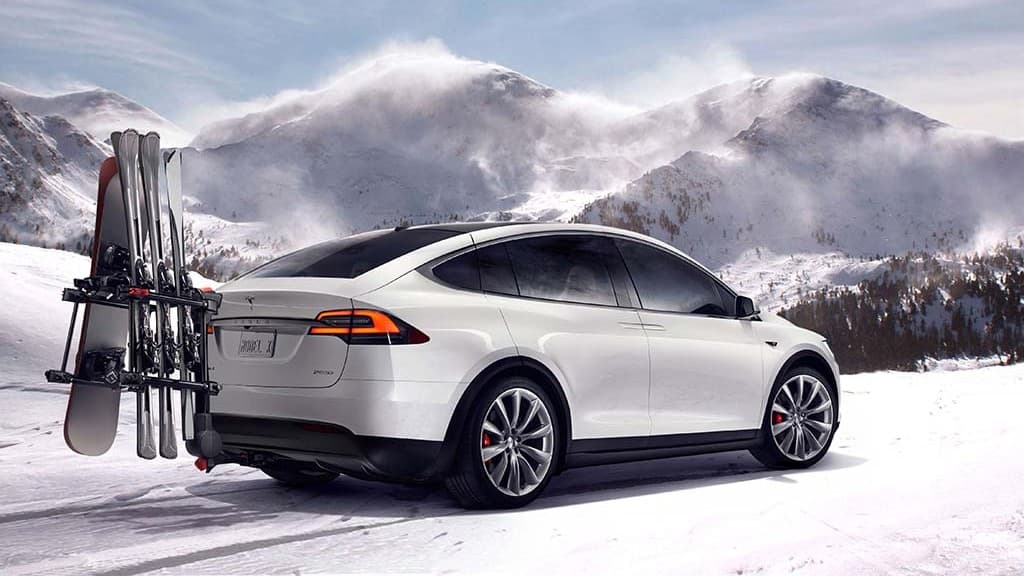
Can you tow a caravan with a Tesla? Can you still have a tow hitch fitted afterwards? And how much range does it cost you? Three questions we get almost every week. Below are the figures per model, the inspection rules (which get a lot more relaxed from September 2026) and the misunderstanding that trips up most people.
What can each Tesla tow?
All values come from the official Tesla owner's manuals and apply to the current generations: the Model 3 "Highland" and the Model Y "Juniper". They apply to a car that is equipped to tow: from the factory via Tesla's Towing-pakket, or fitted afterwards (see below).
> Do you drive an older Model 3 or Model Y? Then your figures are different. There is a separate table for the pre-facelift generations further down.
Model (current generation) | Braked | Unbraked | Max. noseweight | Max. load on bike rack |
|---|---|---|---|---|
Model 3 Highland (RWD or AWD) | 1 000 kg | 750 kg | 100 kg | 55 kg |
Model 3 Highland Performance | 500 kg | n/a | 100 kg | 55 kg |
Model Y Juniper | 1 600 kg | 750 kg | 100 kg | 72 kg |
Model S | 1 600 kg | 750 kg | 100 kg | 54 kg |
Model X | 2 250 kg | 750 kg | 100 kg | n/a |
The noseweight is the downward force of the drawbar on the ball. Tesla prescribes that it stays between 4% and 10% of the total trailer weight, with an absolute maximum of 100 kg. If you load the car itself with passengers and luggage, the permitted noseweight drops, and with it the maximum towing capacity.
Also watch the load capacity for a bike rack: it is much lower than the noseweight for a trailer, because the weight hangs further behind the ball. The weight of the rack itself counts too. An 18 kg rack on a Model 3 therefore leaves room for roughly two 18 kg bikes.
Points to watch per model
Model 3. Mind the version: the Performance tows only 500 kg, half of what a Model 3 with rear-wheel drive or All-Wheel Drive is allowed. Towing is also only permitted on 18" or 19" tyres. If you run larger wheels, you may not tow a trailer with that wheel and tyre package. The trailer brakes cannot be controlled electrically: pins 9 to 13 of the 13-pin connector are not active, and the Model 3 has no brake controller.
Model Y. Unlike the Model 3, the 1 600 kg applies to every wheel configuration. The seven-seat versions do have one extra restriction: a maximum of 100 km/h with a trailer, and a higher tyre pressure (45 psi) on 20" wheels. The maximum rear overhang of the coupling point is 1 064 mm, which matters if you are considering a bike rack that sticks out a long way.
Model X. At 2 250 kg the strongest tow car in the range, and therefore suitable for a full-size caravan. On the largest wheel size, the permitted towing capacity is lower.
Model S. Towing is possible with the Towing-pakket, on 19" or 21" tyres.
> The Model S and Model X are no longer sold new in Belgium. If you want a Tesla that tows more than 1 600 kg, you automatically end up with a second-hand Model X. We are happy to find one for you. Tell us what you want to tow and we will look for a car with the right homologation.
> Always check on your own car: the values on the certificate of conformity (COC), the manufacturer's plate or the tow hitch label take precedence over what the manual says. If the towing capacity reads 0, that car may not tow a trailer at all. Full stop.
Older Teslas: the pre-facelift figures
Most Teslas on the used market, and therefore most of the cars in our stock, date from before Highland and Juniper. Different values apply to those generations.
Model | Model years | Braked | Max. noseweight | Bike rack |
|---|---|---|---|---|
Model 3 (first EU tow hitch option) | 2019 – approx. 2021 | 910 kg | 91 kg | 55 kg\* |
Model 3 (later model years, pre-Highland) | approx. 2021 – 2023 | 1 000 kg | 100 kg | 55 kg\* |
Model 3 Performance pre-Highland | n/a | tow hitch not available | n/a | n/a |
Model Y pre-Juniper | 2021 – early 2025 | 1 600 kg | 100 kg | 72 kg\* |
Model S | n/a | 1 600 kg | 100 kg | 54 kg |
Model X | n/a | 2 250 kg (Plaid) to 2 300 kg (Long Range) | 90 – 100 kg | 54 kg |
\* On these older generations the permitted load on a bike rack drops to 20 kg when you are running 20" wheels and carrying more than two people in the back. That is less than a single e-bike. It is exactly that restriction that disappeared with Highland and Juniper: there the 55 kg and 72 kg apply unconditionally.
Want more background on that generation change? We compare both Model Y generations in detail in Tesla Model Y: Juniper or the previous generation?.
Two things stand out when you put that table next to the new one:
- The early Model 3 tows 910 kg, not 1 000 kg. Tesla introduced the tow hitch option in May 2019 for the European Standard Range Plus and Long Range with a limit of 2 000 lb (910 kg). Only later did that go up to 1 000 kg. For a trailer of around 950 kg, that is the difference between legal and not.
- The Model 3 Performance could not have a tow hitch at all in the past. With Highland it can, although limited to 500 kg. So if you are looking for a Performance that can tow, you need the most recent generation.
> These values come from the manuals of the model years concerned and from specialist sources. They point you in the right direction, but they are no substitute for the COC of the specific car you buy. Tesla has quietly adjusted things over the years, and the car itself is always right.
What does the tow hitch package cost?
Tesla sells the tow hitch package through its own web shop. For both the Model 3 and the Model Y it costs € 1 350. For that you get a steel tow hitch with a detachable ball, the wiring and compatibility with Trailer Mode.
If the car you have your eye on does not have a tow hitch, do not simply assume that figure: fitting comes on top, and a tow hitch from another brand can work out cheaper. Ask us for the total price for that specific car.
Having a tow hitch fitted afterwards: is that allowed?
Yes. You sometimes hear that a car with a retrofitted tow hitch can no longer pass inspection, or that it voids your warranty. Neither is true: having a tow hitch fitted afterwards is perfectly legal and common.
What does count is one rule: what your certificate of conformity says. If your COC states a towing capacity, you may tow up to that weight, including with a tow hitch that was fitted afterwards. If there is no towing capacity, you may not tow, however sturdy that tow hitch may be physically.
On most Teslas that is good news: the Model Y, Model S, Model X and the Model 3 Highland all have a towing capacity on their COC, even when the car was delivered without a tow hitch. A retrofitted tow hitch is therefore a fully valid solution for those cars.
The exception: the pre-Highland Model 3
A Model 3 from before the Highland generation that was delivered without the Towing-pakket has no towing capacity on its COC. That is where you run into the difference between:
- load capacity: what you may hang vertically on the ball, so a bike rack
- towing capacity: what you may pull behind you, so a trailer or a caravan.
You can perfectly well fit such a Model 3 with a tow hitch, but all you get is load capacity. Carrying bikes: no problem. A trailer or a caravan: not legally permitted, even though the ball fits.
So if you are looking for an older Model 3 to tow with, the factory option is a real search criterion. With the other models it is not.
What about the inspection?
On 1 September 2026 something important changes here in Flanders, and it is good news. If you are having a tow hitch fitted, keep an eye on that date.
From 1 September 2026 no separate inspection will be required for fitting a tow hitch. A voluntary inspection of your tow hitch will still be possible and allowed, but it will no longer be compulsory.
Just as important: from that date a car with a tow hitch gets the same inspection interval as a car without one. Today a tow hitch rated above 750 kg still pushes you into an annual inspection; that extra frequency will disappear. For passenger cars the periodic inspection also goes from annual to every two years on that same date.
Up to and including 31 August 2026 the old arrangement still applies: as soon as the coupling device has been fitted and before you use it, you must present the car at the inspection centre of your own accord. That also applies when the tow hitch was fitted at the factory on a new car. One exception: a genuine bike-rack mount, a system that can only carry a bike rack and that you may not pull anything with, did not have to be inspected separately even then. Take with you to the inspection: the vehicle registration document, the certificate of conformity (COC) and your most recent inspection certificate.
In concrete terms: if you have your tow hitch fitted before September, count on one more trip to the inspection centre. If the work can wait until afterwards, that saves you the trip and keeps your car on the same inspection rhythm.
Source: Vlaanderen.be, new rules for the technical inspection.
> Please note: these are the Flemish rules. Technical inspection is a regional competence, and Brussels and Wallonia may apply different conditions. If you live outside Flanders or have your car inspected there, check the rules of your own region.
What does not change: the inspection obligation disappears, the rules on what you may tow do not. Your certificate of conformity still determines whether and how much you may pull (see above), and a correctly fitted, approved tow hitch remains a requirement. The inspection was never what gave you the right to tow; your COC did that.
And what about the warranty?
Here too, some nuance is needed. Your Tesla warranty does not lapse because a tow hitch was fitted to your car afterwards. A Dutch tow hitch specialist put that question directly to Tesla: the factory warranty is fully retained, with the single caveat that Tesla does not cover consequential damage from the fitting.
What Tesla itself states in the manual confirms that picture:
- damage caused by towing a trailer is not covered by the warranty
- damage caused by a carrier that is not approved by Tesla is not covered by the warranty
- for towing itself you must use Tesla's tow hitch.
So the risk lies with damage that demonstrably comes from the fitting, the towing or non-approved parts, not with your whole car. Either way, have the work done by a specialist who gives a warranty on their own installation.
What does a trailer cost you in range?
Tesla is clear about it: weight and air resistance go up, and range drops considerably. The manufacturer does not give a concrete percentage, and rightly so: it depends entirely on what you are towing.
What we see in practice:
- a caravan or large enclosed trailer: count on roughly halving your range. Frontal area matters more here than weight.
- an open trailer or luggage trailer: noticeably less loss, but still substantial, because the impact scales with speed.
- a bike rack with bikes: a smaller effect, but still clearly noticeable at motorway speeds.
The Trip Planner adjusts its estimate when Trailer Mode is active, but expect your real consumption to differ. Plan your charging stops with more margin than the car suggests, certainly on your first trip.
In practice: how to do it properly
- Always switch on Trailer Mode. If you connect the electrical plug while the car is in P, it switches on by itself. Unplugging does not switch it off automatically; you have to do that yourself.
- In Trailer Mode the cruise control keeps more distance, automatic steering correction on a side collision warning is switched off, and the braking force of the emergency brake may be limited.
- Remove the tow hitch arm when you are not using it, store it dry and put the dust cap back on.
- Distribute your load so that the noseweight stays between 4% and 10% of the total weight. If the car sags at the back, you are too heavy.
- Cross the safety chains under the ball, with enough slack for corners but without them dragging.
- Never use the tow hitch to have the Tesla itself towed away.
- A carrier can block the view of the reversing camera and the sensors; some driver assistance features then work differently.
Our conclusion
A Tesla is a fine tow car within its limits: the Model X takes a real caravan, the Model Y tows 1 600 kg on every wheel size, and the Model 3 is made for a luggage or bike trailer. Do look carefully at the version, though: a Model 3 Performance is stuck at 500 kg, and that is exactly the kind of detail you only discover once the trailer is already on your driveway.
The most important thing to remember: your certificate of conformity decides, not the tow hitch. If it states a towing capacity, you may tow, even when the tow hitch was fitted afterwards. For the Model Y, S, X and the Model 3 Highland that is the case.
The only real pitfall is a pre-Highland Model 3 without the factory option: it gets no towing capacity and is therefore limited to a bike rack. If you are looking for such a car to tow with, watch out for the factory option and for the generation: 910 or 1 000 kg, Performance or not.
At CarMatch we check this for every car in our stock. Tell us what you want to tow (a bike rack with two e-bikes, a luggage trailer or a caravan) and we will look for a car whose certificate of conformity actually allows it.
Frequently asked questions
How much can a Tesla Model Y tow?
1 600 kg braked and 750 kg unbraked, with a maximum noseweight of 100 kg. The car has to be fitted with Tesla's Towing-pakket.
How much can a Tesla Model 3 tow?
1 000 kg braked with rear-wheel drive or All-Wheel Drive, and 750 kg unbraked. The Model 3 Performance may only tow 500 kg. Towing is only permitted on 18" or 19" tyres.
What does a tow hitch on a Tesla cost?
Tesla's tow hitch package costs € 1 350 for both the Model 3 and the Model Y, excluding fitting if the car does not have one yet.
Which Tesla tows the most?
The Model X, with 2 250 kg. It is no longer sold new in Belgium, so that will be a second-hand car.
My Tesla was delivered without a tow hitch. Can I have one fitted afterwards?
Yes. What matters is whether your certificate of conformity states a towing capacity. For the Model Y, Model S, Model X and the Model 3 Highland it does, even without the factory option. You may then tow up to that weight with a tow hitch that was fitted afterwards. If you have it fitted before 1 September 2026, you still have to have it inspected straight away in Flanders; after that date the obligation disappears.
And with an older Model 3?
A Model 3 from before the Highland generation that was delivered without the Towing-pakket has no towing capacity on its COC. You can have a tow hitch fitted for a bike rack, but you are not legally allowed to tow with it. If you want to tow a trailer with such a car, look for one that got the tow hitch option from the factory.
Does my tow hitch have to be inspected?
In Flanders, yes up to and including 31 August 2026: you present the car of your own accord as soon as the tow hitch has been fitted. From 1 September 2026 that separate inspection disappears and your car keeps the same inspection interval as a car without a tow hitch. A voluntary inspection remains possible. Technical inspection is a regional competence, so different rules may apply outside Flanders.
Does a tow hitch void my Tesla warranty?
No. Tesla confirmed to a tow hitch specialist that the factory warranty is retained; only consequential damage from the fitting or from the towing itself falls outside it.
How much can an older Model 3 tow?
The first European tow hitch option from 2019 was homologated for 910 kg with a noseweight of 91 kg. Later model years went to 1 000 kg and 100 kg. Check your COC for the exact figure for your car.
Can a Model 3 Performance have a tow hitch?
On the current Highland generation it can, limited to 500 kg. On the generations before that, there was no tow hitch option for the Performance at all.
How much range do I lose with a caravan?
In practice, count on roughly half. With an open trailer or a bike rack the loss is smaller, but it goes up with speed.
Can I have the trailer brakes controlled electrically?
Not on the Model 3: pins 9 to 13 of the 13-pin connector are not active and there is no brake controller. A trailer of more than 750 kg therefore needs its own independent braking system.